
What Defines a Seasoned Tradeline?
It’s not just age — and “seasoned” isn’t the same thing as “aged,” even though the terms get used interchangeably.
Ready to browse? See our AU tradeline inventory.

Written by
Raquel Hudson, Tradeline Specialist
More than a decade of experience in tradeline placement, credit report analysis, and client support. Read her full background →

A seasoned tradeline reflects stability, not just longevity. Account age alone isn’t enough — a truly seasoned tradeline combines multiple factors that influence how it’s actually viewed in underwriting and scoring.
“Aged” vs. “Seasoned” — Not Quite the Same Word
These terms get used interchangeably, but they’re not identical. “Aged” typically just describes account longevity — the market convention treats accounts five years or older as genuinely aged. “Seasoned” is narrower: it implies age combined with a clean, consistent payment record. A 12-year-old account with several late payments is aged, but not meaningfully seasoned — the history undermines the age.
Core Factors That Define “Seasoned”
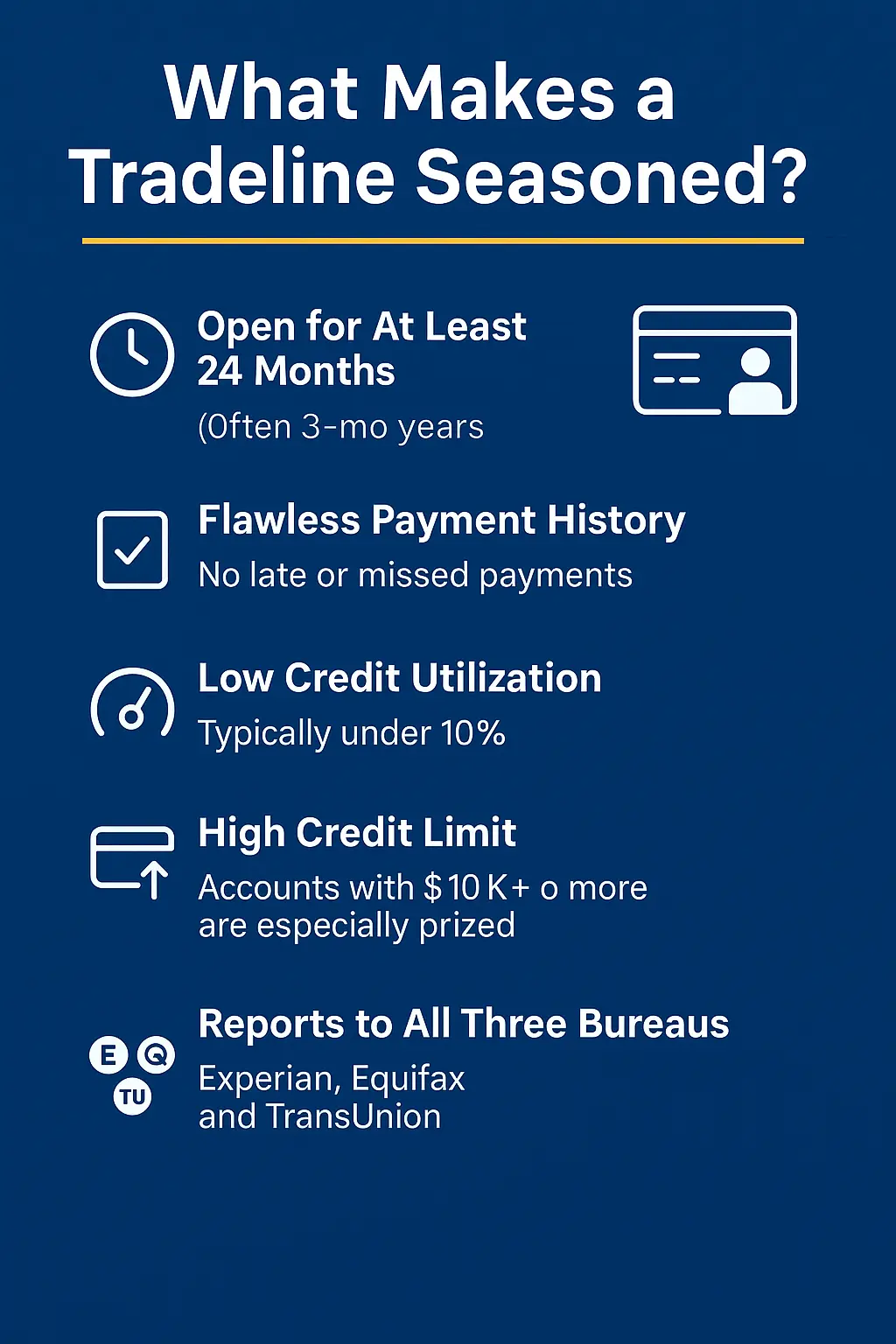
- Account age — most industry usage treats 2+ years as the baseline, with accounts past 3-5 years typically seeing stronger demand. There’s no fixed minimum required to be listed at all — cards are reviewed individually.
- Consistent, on-time payment history — even one late payment reduces the credibility of an otherwise aged account
- Low utilization — under 10% is generally considered strong
- Bureau reporting — reporting to at least two major bureaus (Experian, Equifax, TransUnion)
Age alone doesn’t guarantee quality — an old account with high utilization or spotty reporting isn’t premium inventory just because it’s old.
Why Age Carries Real Weight in Scoring
Credit scoring models consider length of credit history a meaningful factor — a longer history contributes to average account age and overall stability. For general background on how tradelines function and appear on credit reports, see Experian’s explainer.
Common Misconceptions
“Age alone is enough.” An old account with high utilization or inconsistent reporting isn’t premium seasoned inventory just because it’s old.
“All 2-year accounts are equal.” Not necessarily — payment history and limit matter significantly on top of age.
“A higher price always means better quality.” Pricing reflects demand, but due diligence still matters regardless of cost.
Seasoned vs. New Tradelines
For a full side-by-side comparison, see Seasoned vs. New Tradelines.
Frequently Asked Questions
What qualifies a tradeline as seasoned?
Generally, 2+ years of age combined with clean, on-time payment history, low utilization, and reporting to at least two major bureaus.
Is “seasoned” the same as “aged”?
Not quite — “aged” typically just refers to account longevity, while “seasoned” implies that age is paired with a genuinely clean payment history.
Can a tradeline be too old?
No — accounts exceeding five years often see greater demand, provided the reporting history stays clean.
Do seasoned tradelines guarantee a score increase?
No. No tradeline can guarantee a specific outcome — impact depends on your full credit profile, not any single account.
Browse Real Seasoned Inventory
Every listing discloses real age, limit, and bureau coverage — no guesswork.