
Tradeline Seller Payout Guide
Understanding how seller payments work, what influences your earnings, and how to maximize payouts on the Tradeline Score platform.
Selling trusted AU tradelines can become a structured and reliable income stream when approached correctly. However, one of the most common questions new sellers ask is simple: How and when do I get paid? This Tradeline Seller Payout Guide was created to answer that clearly.
If you are just getting started, it is highly recommended to review How to Sell Tradelines for Profit before listing your first card. You should also confirm that your accounts meet the AU Tradeline Seller Eligibility Requirements to avoid delays.
This guide will walk you through:
-
What determines your payout amount
-
How escrow affects payment timing
-
What can delay payouts
-
How to increase your earnings over time
-
How top sellers scale efficiently

Why Understanding the Payout Model Matters
Many sellers focus only on listing their cards, but long-term success depends on understanding how payouts are structured.
From our experience, sellers who understand the Tradeline Seller Payout Guide early tend to:
-
Avoid payout delays
-
Maintain stronger seller rankings
-
Earn repeat orders
-
Scale faster with fewer issues
Transparency drives consistency. And consistency drives income.
The Tradeline Seller Payout Guide is not just about numbers. It is about building a repeatable system that protects your card, your time, and your earnings.
How Seller Payouts Work on Tradeline Score
Tradeline Score operates using an escrow-backed structure. This means payments are processed through a secure system that protects both buyers and sellers.
Here is the simplified flow:
-
A buyer selects your tradeline listing
-
Funds are secured in escrow
-
You add the authorized user
-
Posting is verified
-
Funds are released
Escrow ensures that payment is not released until the tradeline posts successfully within the expected reporting window.
If you want to better understand how this protection works, you can review the Compliance & Escrow Process for a full breakdown of transaction safeguards.
What Determines Your Tradeline Payout?
Your payout amount is not random. It is based on measurable characteristics of your card and your performance as a seller.
1. Card Age
Older accounts typically earn higher payouts.
-
1–2 year accounts are considered entry-level
-
3–4 year accounts are mid-tier
-
5+ year accounts are premium
Longer account history increases listing desirability.
2. Credit Limit
Higher limits increase listing desirability. If you want a clearer understanding of how tradelines are categorized and displayed on credit reports, this explanation of tradelines on a credit report offers a straightforward overview of how lenders interpret account data..
-
$2,000–$4,000 limits attract smaller placements
-
$5,000–$9,000 limits are more competitive
-
$10,000+ limits typically qualify for premium demand
Buyers looking to optimize utilization often prioritize higher limits.
3. Utilization Ratio
Maintaining utilization below 15% significantly improves listing performance.
Below 10% is generally considered optimal.
Sellers who maintain stable balances tend to receive more consistent orders.
4. Statement Date Accuracy
Accurate statement dates reduce posting confusion.
Sellers who update statement cycles regularly experience fewer disputes.
5. Seller Performance History
Your seller score is influenced by:
-
On-time AU additions
-
Accurate removals
-
Responsive communication
-
Clean posting record
Following the Tradeline Seller Payout Guide closely improves your visibility within the marketplace.
To ensure your cards remain competitive, revisit the AU Tradeline Seller Eligibility Requirements periodically.
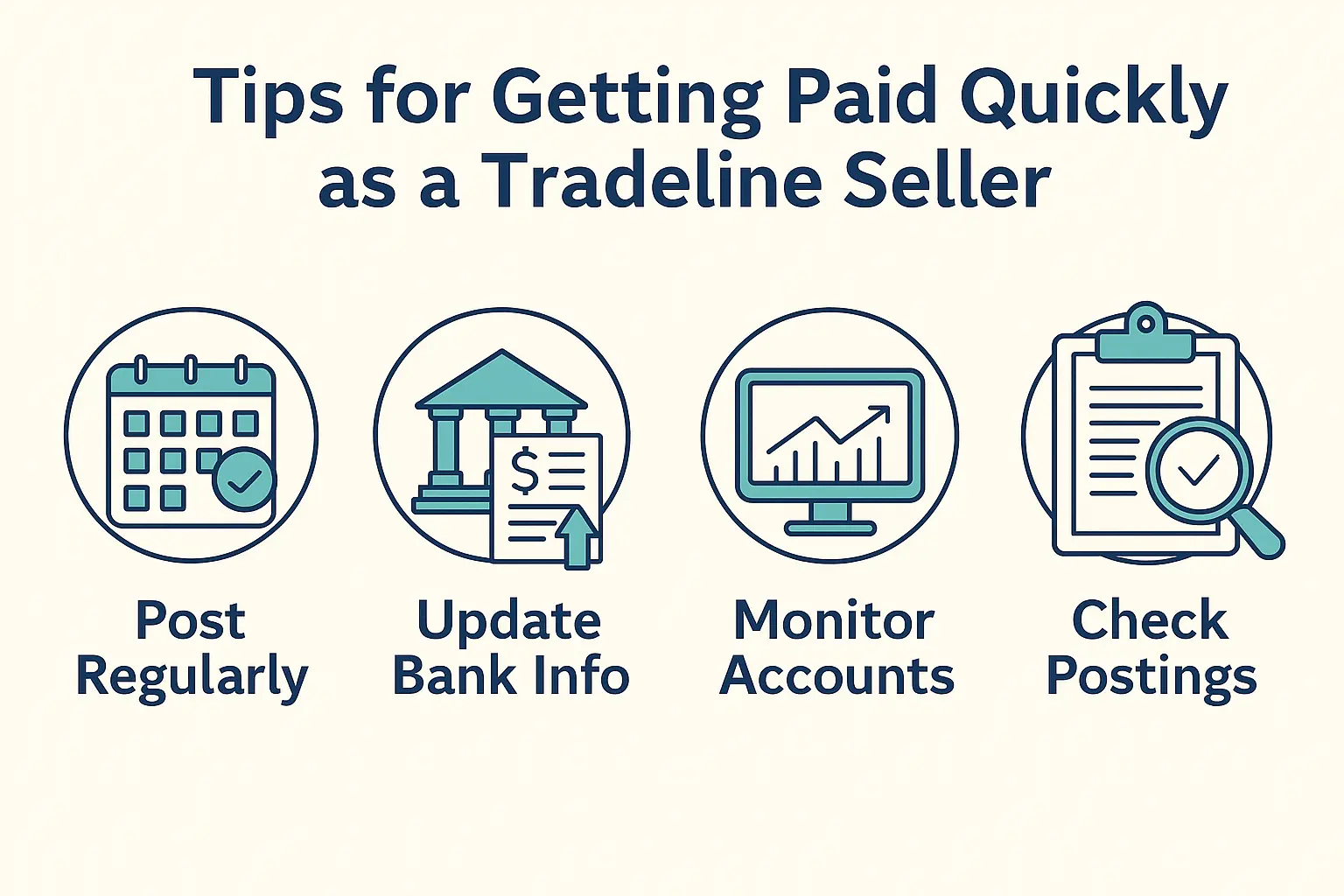
Typical Payout Ranges
While earnings vary, here are common ranges based on account quality:
-
1–2 year card with $2K–$4K limit: $40–$90 per slot
-
3–4 year card with $5K–$9K limit: $100–$175 per slot
-
5+ year card with $10K+ limit: $200–$350+ per slot
These are illustrative ranges. Actual demand depends on timing, utilization, and overall seller reliability.
Many sellers generate steady monthly income by listing multiple qualifying cards. Two strong aged accounts can outperform five low-tier accounts if managed properly.
Escrow Protection and Payment Timing
Escrow plays a central role in payout timing.
Once your tradeline posts successfully:
-
Posting verification occurs
-
A short holding window passes
-
Funds are released
In most cases, payouts are initiated within 3–5 business days after verification.
Escrow protects you from chargebacks and protects buyers from premature release. It creates a balanced system.
This structured approach is part of what makes Tradeline Score different from informal marketplaces.
What Can Delay a Seller Payout?
Understanding potential delays helps you avoid them.
Common causes include:
-
Missing verification screenshots
-
Incorrect statement date information
-
Utilization spikes mid-cycle
-
Failure to remove authorized users on time
-
Incomplete seller documentation
The Tradeline Seller Payout Guide exists to minimize these issues.
Sellers who monitor their dashboard closely and respond quickly to notifications typically experience faster payout cycles.
Tradeline Seller Payout Process
- Tradeline Posts Successfully
Once your tradeline posts to the buyer’s credit report, the payout clock starts ticking. - Protected by Escrow
Funds are held in secure escrow while post-verification is completed to protect both parties. - 7-Day Holding Period
A short hold period reduces fraud and ensures buyer satisfaction before releasing funds. - Payout Released to Wallet
Once cleared, funds are instantly available in your Tradeline Score wallet. - Withdraw Funds Anytime
Withdraw your balance via Zelle, ACH, or wire transfer from your seller dashboard anytime.
How to Increase Your Earnings Over Time
Top-performing sellers tend to follow similar patterns.
List Multiple Qualified Cards
Diversification increases order volume.
Maintain Low Utilization
Lower balances attract more consistent buyers.
Update Statement Dates Regularly
Accuracy builds trust.
Accept Orders Quickly
Fast response improves seller ranking.
Maintain Perfect Payment History
Clean history increases repeat demand.
Stay Active
Inactive sellers drop in priority.
For a complete walkthrough of building your seller portfolio strategically, review How to Sell Tradelines for Profit to align your listings with platform best practices.
Scaling as a Tradeline Seller
Many sellers start with one qualifying card. Over time, they scale by:
-
Adding additional aged accounts
-
Improving credit limits
-
Managing utilization carefully
-
Maintaining reliable fulfillment
Scaling is less about volume and more about consistency.
Reliable sellers often see:
-
Increased slot bookings
-
Higher-tier placements
-
More predictable payout flow
The seller dashboard centralizes:
-
Order tracking
-
Verification status
-
Escrow release updates
-
Withdrawal options
Structured sellers outperform reactive sellers.
Withdrawal Methods
Once funds clear escrow, sellers can withdraw via:
-
ACH transfer
-
Zelle
-
Wise
-
Wire transfer
There is no minimum payout threshold for completed tradelines. Each verified posting generates its own payout event.
This gives sellers flexibility and control over cash flow.
Compliance and Seller Responsibility
Understanding federal credit reporting standards strengthens your seller performance. For additional context on how authorized user accounts are reflected on credit reports, this guide to authorized user accounts provides a helpful educational breakdown of reporting behavior and visibility.
While the platform enforces internal compliance standards, sellers who educate themselves on broader regulatory frameworks reduce long-term risk.
Compliance is not just about protection. It supports sustainability.
Common Seller Mistakes to Avoid
Avoid these errors:
-
Listing cards with fluctuating utilization
-
Ignoring dashboard alerts
-
Delayed removals
-
Overpromising posting speed
-
Neglecting eligibility requirements
The Tradeline Seller Payout Guide is designed to help sellers operate predictably and professionally.
Frequently Asked Questions
When will I receive my payout?
After posting verification and escrow clearance, typically within 3–5 business days.
What if a tradeline fails to post?
If seller guidelines were not followed, payout is not issued. If compliance standards were met, resolution protocols apply.
Is there a payout minimum?
No. Each successful tradeline is paid individually.
How do I maximize earnings?
List aged, high-limit cards, maintain low utilization, and follow structured fulfillment practices.
Where can I manage my listings?
All orders and payouts are tracked in your seller dashboard. You can also revisit the homepage to explore additional seller tools and resources.
Long-Term Seller Strategy
Professional sellers treat tradeline management like a system:
-
Track statement cycles
-
Maintain low balances
-
Document additions and removals
-
Stay responsive
-
Follow eligibility standards
Income becomes predictable when processes are repeatable.
The Tradeline Seller Payout Guide reinforces structure because structure produces stability.
Final Thoughts on the Tradeline Seller Payout Guide
The Tradeline Seller Payout Guide provides clarity on how earnings are calculated, verified, and released within the Tradeline Score marketplace. Payout amounts are influenced by account age, credit limit, utilization, and seller performance history. Escrow-backed processing ensures payments are released only after verified posting, protecting both buyers and sellers. Sellers who maintain low utilization, respond promptly to orders, update statement information accurately, and follow eligibility standards typically experience smoother payout cycles and stronger long-term earning potential. Structured management, transparency, and reliability form the foundation of sustainable tradeline seller income growth.
