
What Makes a Tradeline “Seasoned”?
Understanding what makes a tradeline seasoned is essential for brokers, buyers, and sellers navigating the authorized user tradeline market. While the term “seasoned tradeline” is commonly used, many people misunderstand what actually qualifies an account as seasoned – and why it matters.
At its core, a seasoned tradeline reflects stability, longevity, and consistent credit behavior. But account age alone is not enough. A truly seasoned AU tradeline combines multiple performance factors that influence how it appears in underwriting reviews and credit scoring models.
If you’re evaluating tradelines for purchase or listing inventory as a seller, knowing what makes a tradeline seasoned allows you to make more strategic decisions.
You can return to the Homepage or browse AU Tradelines for Sale to explore live inventory.

Why the Term “Seasoned” Matters
In credit reporting, longevity signals trust.
When lenders evaluate credit profiles, they look for patterns of long-term responsible usage. A seasoned tradeline demonstrates that an account has been open and managed successfully over time. That history contributes to perceived stability.
However, what makes a tradeline seasoned is not just its age – it is the combination of:
-
Account longevity
-
On-time payment history
-
Low credit utilization
-
Consistent bureau reporting
-
Stable credit limits
These variables together define whether a tradeline truly qualifies as seasoned.
Core Factors That Define What Makes a Tradeline Seasoned
Let’s break down the primary characteristics.
1. Account Age (Minimum 24 Months)
Age is the foundational element.
Most industry professionals consider a tradeline seasoned once it has been open for at least two years, though accounts exceeding three to five years typically carry stronger demand.
Longer account history increases:
-
Average age of credit
-
Length of credit history
-
Perceived stability
From our experience, tradelines older than five years with clean reporting history are often prioritized by brokers working with higher-expectation clients.
However, age alone does not guarantee quality.
2. Perfect Payment History
A seasoned tradeline must reflect consistent, on-time payments.
Even a single late payment can reduce the credibility of an otherwise aged account.
Payment consistency demonstrates responsible credit behavior over time – one of the most important variables in scoring models.
When evaluating what makes a tradeline seasoned, payment history often matters as much as age.
3. Low Utilization (Typically Under 10%)
Utilization reflects how much of the credit limit is currently being used.
Seasoned tradelines typically maintain:
-
Under 10% utilization
-
Stable balance patterns
-
No sudden balance spikes
Low utilization strengthens the tradeline’s profile and enhances its appeal for brokers targeting utilization optimization strategies, especially when you understand how credit utilization affects your credit score.
Accounts with long age but high utilization rarely qualify as premium seasoned inventory.

4. High Credit Limit
Higher limits contribute to stronger utilization ratios and greater perceived credit capacity.
While there is no universal threshold, seasoned tradelines with:
-
$5,000+ limits
-
$10,000+ limits (premium tier)
tend to command stronger pricing and higher demand.
When combined with long age and perfect history, higher limits significantly increase tradeline value.
5. Consistent Bureau Reporting
A seasoned tradeline must report reliably.
Consistency includes:
-
Reporting to at least one major bureau
-
Preferably reporting to all three (Experian, Equifax, TransUnion)
-
Predictable statement cycle behavior
Accounts that fluctuate in reporting frequency may not deliver the stability typically associated with seasoned inventory.
Understanding reporting timelines is critical, which is why many brokers review the Authorized User Tradeline Timeline before placement.
Seasoned vs. New AU Tradelines
To fully understand what makes a tradeline seasoned, it helps to compare seasoned accounts with newer tradelines.
New Tradelines (Under 12 Months)
-
Limited credit history
-
Lower reporting depth
-
Typically lower cost
-
May help short-term utilization
Seasoned Tradelines (24+ Months)
-
Established reporting history
-
Higher demand
-
Greater stability
-
Preferred for underwriting scenarios
While newer tradelines may serve certain short-term goals, seasoned accounts generally provide stronger long-term credit structure support.
For a detailed side-by-side breakdown, see our Seasoned vs New Tradelines Comparison.
Why Credit Age Carries So Much Weight
Credit scoring models place meaningful emphasis on the age of accounts.
Longer credit history contributes to:
-
Higher average account age
-
Stronger oldest account metric
-
Improved stability profile
Understanding what makes a tradeline seasoned means recognizing how these age-related metrics interact with scoring systems.
If you’re new to how tradelines function overall, this guide explains tradelines in simple terms and outlines how they appear on credit reports.
What Makes a Tradeline Seasoned Beyond the Basics
There is also a qualitative component.
In practice, seasoned tradelines often demonstrate:
-
Stable statement cycles
-
No frequent authorized user removals
-
Clean historical reporting
-
No issuer instability
Many experienced sellers find that maintaining disciplined utilization patterns and predictable reporting improves their tradeline’s reputation over time.
Seasoned inventory tends to attract repeat broker demand because reliability compounds.
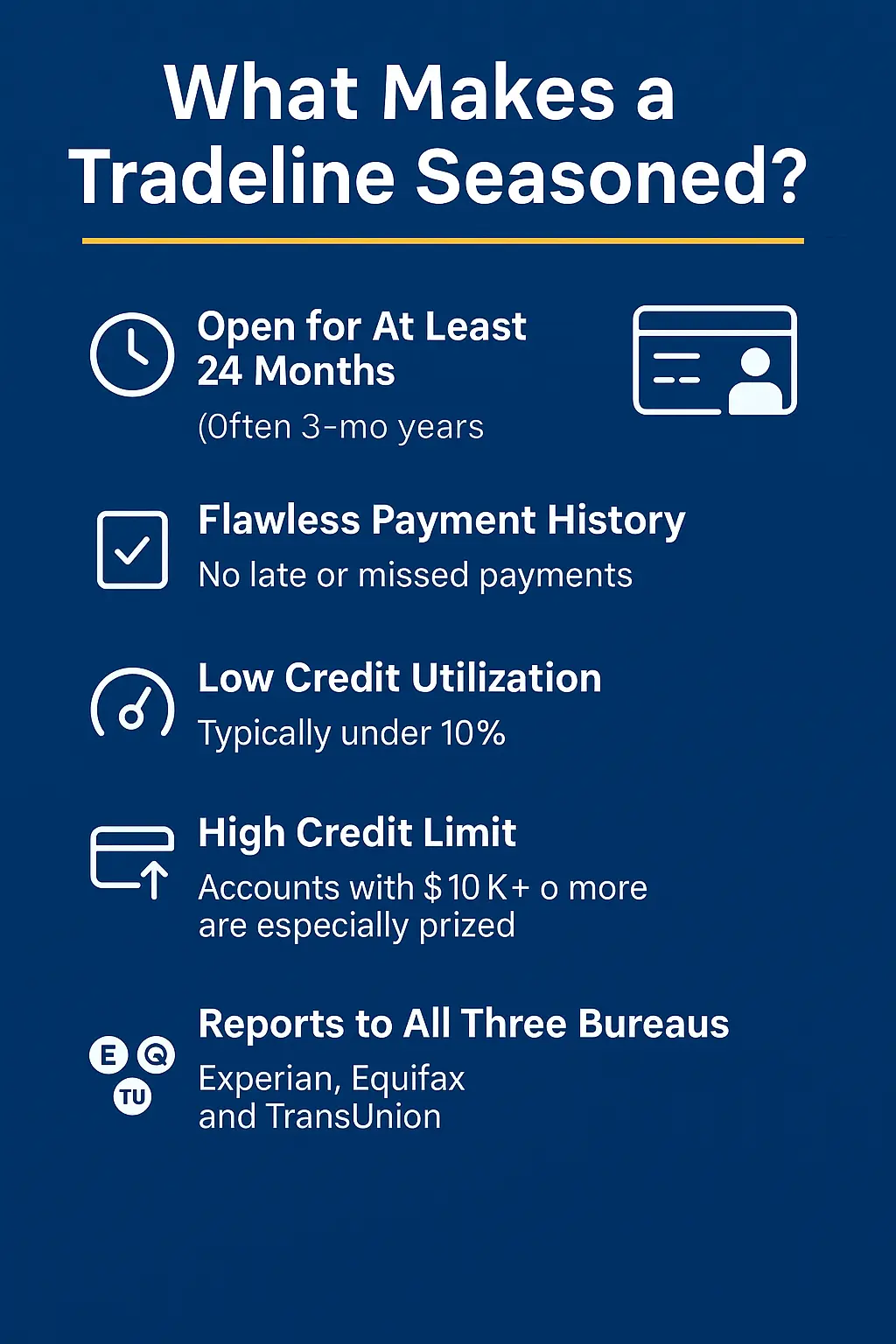
What Makes a Tradeline Seasoned?
- Account Age: At least 2 years old, ideally 3+ for stronger credit impact.
- Perfect Payment History: No missed or late payments over the life of the account.
- Low Utilization: Typically below 10% of the credit limit used.
- High Credit Limit: Limits of $10,000+ are preferred by lenders and scoring models.
- Full Bureau Reporting: Must report to all 3 major credit bureaus (Experian, Equifax, TransUnion).
- Authorized User Eligible: Allows AU piggybacking to leverage credit-building benefits.
Seasoned tradelines offer more value because they strengthen both age and payment history – two of the most important factors in FICO and VantageScore models.
Why Credit Age Carries So Much Weight
Credit scoring models place meaningful emphasis on the age of accounts.
Longer credit history contributes to:
-
Higher average account age
-
Stronger oldest account metric
-
Improved stability profile
Understanding what makes a tradeline seasoned means recognizing how these age-related metrics interact with scoring systems.
If you’re new to how tradelines function overall, this Discover guide explains tradelines in simple terms and outlines how they appear on credit reports.
What Makes a Tradeline Seasoned Beyond the Basics
There is also a qualitative component.
In practice, seasoned tradelines often demonstrate:
-
Stable statement cycles
-
No frequent authorized user removals
-
Clean historical reporting
-
No issuer instability
Many experienced sellers find that maintaining disciplined utilization patterns and predictable reporting improves their tradeline’s reputation over time.
Seasoned inventory tends to attract repeat broker demand because reliability compounds.
Common Misconceptions About Seasoned Tradelines
Misconception 1: Age Alone Is Enough
False. An old account with high utilization or inconsistent reporting is not premium seasoned inventory.
Misconception 2: All 2-Year Accounts Are Equal
Not necessarily. Payment history and limit matter significantly.
Misconception 3: Higher Cost Always Means Better
Pricing reflects demand, but due diligence is still required.
Frequently Asked Questions
What qualifies a tradeline as seasoned?
Typically, a tradeline becomes seasoned after 24 months of clean reporting, low utilization, and consistent payment history.
Why is age so important?
Credit scoring models value longer credit history because it reflects sustained financial behavior over time.
Can a tradeline be too old?
No. In fact, accounts exceeding five years often carry greater demand – provided reporting remains clean.
Do seasoned tradelines guarantee score increases?
No tradeline guarantees a specific score result. Impact varies depending on the full credit profile structure.
Where can I compare seasoned tradeline pricing?
You can review live pricing tiers on our Tradeline Prices page to compare inventory based on age and limit.
Choosing Seasoned Inventory Strategically
If you are browsing available listings, evaluate:
-
Account age
-
Utilization ratio
-
Credit limit
-
Bureau coverage
-
Seller performance consistency
For those considering a broader strategy, exploring seasoned AU tradelines can help you understand how established accounts fit within structured credit planning.
Final Thoughts on What Makes a Tradeline Seasoned
Understanding what makes a tradeline seasoned requires more than looking at the open date. A truly seasoned AU tradeline reflects a combination of long-standing account age, perfect payment history, low utilization, stable reporting patterns, and meaningful credit limits. When these factors align, the tradeline demonstrates consistency and reliability – two attributes that scoring models and underwriting reviews tend to favor. By evaluating seasoned accounts through a comprehensive lens rather than focusing on age alone, brokers, buyers, and sellers can make more informed decisions and prioritize stability over short-term positioning.
