
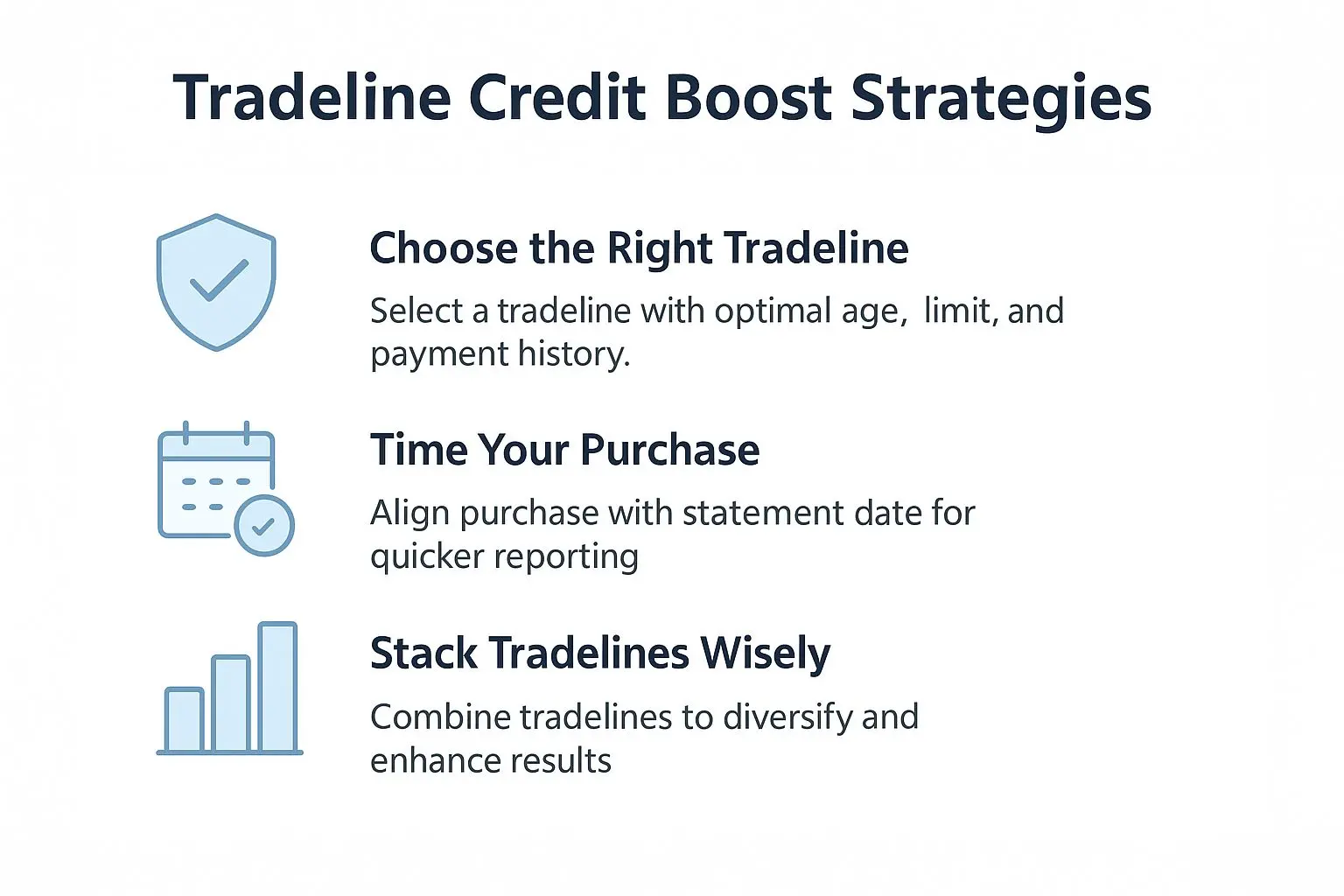
Tradeline Credit Boost Strategies
Understanding how tradelines interact with your credit profile is essential if you’re exploring ways to strengthen your report structure responsibly. While no tradeline can guarantee a specific credit score outcome, applying smart tradeline credit boost strategies can support improvements in areas such as account age, utilization ratios, and reporting diversity.
Tradelines are tools – not shortcuts. When used strategically and aligned with your overall financial behavior, they can contribute to a stronger and more stable credit profile.
If you’re new to the process, you can explore Tradeline Score’s homepage to see how our escrow-backed marketplace operates, or browse our secure AU tradeline marketplace to review available options.

account age, utilization ratios, and reporting diversity.
Tradelines are tools — not shortcuts. When used strategically and aligned with your overall financial behavior, they can contribute to a stronger and more stable credit profile.
If you’re new to the process, you can explore Tradeline Score’s homepage to see how our escrow-backed marketplace operates, or browse our trusted AU tradeline inventory to review available options.
Why Strategy Matters More Than the Tradeline Itself
One of the most common mistakes people make is selecting a tradeline based solely on price or age. In practice, effective tradeline credit boost strategies depend on timing, structure, and compatibility with your existing credit profile.
From our experience, the most consistent outcomes occur when buyers:
-
Review their credit report first
-
Identify specific profile weaknesses
-
Match tradeline attributes to those weaknesses
-
Align purchases with reporting cycles
-
Avoid stacking without purpose
In other words, the strategy drives the outcome — not just the account itself.
Core Components of Smart Tradeline Credit Boost Strategies
To apply tradelines responsibly, you must understand how they interact with scoring models.
Tradelines may influence:
-
Average age of accounts
-
Overall credit utilization
-
Revolving account mix
-
Length of credit history
-
Reporting activity patterns
However, every credit file is unique. A tradeline that benefits one profile may have minimal impact on another.
That’s why effective tradeline credit boost strategies start with assessment.
1. Match Tradeline Age to Your Profile Needs
Account age plays a significant role in many scoring models, and understanding how length of credit history impacts your credit score can help you align your tradeline strategy more effectively.
If your credit file is relatively new or “thin,” adding a seasoned tradeline (typically 24+ months old) may contribute to increasing your average account age.
However, if your file already includes older primary accounts, the marginal benefit of adding another aged tradeline may be smaller.
Understanding the difference between newer and seasoned accounts can help clarify selection decisions, which is why reviewing a Seasoned vs New Tradelines Comparison often helps before committing to a purchase.
The key is alignment — not overcorrection.
2. Focus on Utilization Strategy
Credit utilization — the ratio between your credit balances and available limits — is one of the more sensitive components of scoring systems.
If your utilization is currently high, selecting a higher-limit tradeline with low utilization may help reduce your overall ratio.
For example:
-
A $15,000 limit tradeline with 5% utilization may influence your total available credit differently than a $2,000 tradeline with 40% usage.
Understanding how credit utilization affects your credit score can provide additional context when applying utilization-based tradeline credit boost strategies.
Still, utilization adjustments work best when paired with responsible debt management on existing accounts.
3. Time Your Purchase Around Reporting Cycles
Timing is often overlooked.
Most revolving accounts report after the statement date, not the day you’re added as an authorized user.
In practice, effective tradeline credit boost strategies involve:
-
Identifying the card’s statement date
-
Adding the authorized user before that cycle closes
-
Allowing 7–30 days for bureau reflection
-
Monitoring your report updates
If you’re unfamiliar with how reporting cycles work, reviewing the Authorized User Tradeline Timeline can clarify expectations.
Buying too late in a billing cycle may delay visibility.
Buying too early without a clear objective may reduce strategic alignment.
4. Avoid Over-Stacking
There is a misconception that more tradelines always equal stronger outcomes.
In reality, stacking multiple tradelines without structure can:
-
Create irregular reporting patterns
-
Raise underwriting questions
-
Reduce perceived authenticity
-
Add unnecessary expense
Most structured tradeline credit boost strategies involve:
-
One to three well-aligned accounts
-
Different purposes (age + utilization, for example)
-
Clear objective per tradeline
Quality consistently outperforms quantity.
📈 Top Tradeline Credit Boost Strategies
Choose Seasoned Tradelines (≥2 Years Old)
The older the tradeline, the stronger the impact on the age of your credit history — a key FICO factor.
Pick Low-Utilization Cards
AU tradelines with under 10% utilization can improve your credit score by reducing overall credit usage.
Stack Strategically — Don’t Overdo It
Buying 2–3 high-quality tradelines is usually more effective than stacking 5+. Focus on quality, not quantity.
Time It Right Before Major Applications
Apply tradelines 15–30 days before a mortgage, auto loan, or credit card application for maximum score visibility.
Always Use Escrow-Protected Platforms
Using a secure escrow platform ensures you’re protected in case the tradeline doesn’t post as expected.
Using Tradelines Before Major Financial Applications
Some buyers explore tradelines before:
-
Mortgage applications
-
Auto financing
-
Rental approvals
-
Business credit applications
If you are planning a major application, timing matters.
Adding a tradeline 15–30 days before a lender pulls your report may allow sufficient time for posting visibility — provided reporting cycles align.
However, tradelines should complement — not replace — responsible financial behavior.
Lenders also evaluate:
-
Debt-to-income ratios
-
Payment history consistency
-
Employment stability
-
Existing liabilities
Tradelines are one component of a broader profile review.
If you’re still exploring whether tradelines fit your situation, reviewing trusted AU tradeline options can help you understand what’s available and frame expectations appropriately.
Evaluating Your Current Credit Profile First
Before implementing tradeline credit boost strategies, review your credit report carefully.
Look for:
-
Address inconsistencies
-
Fraud alerts
-
Credit freezes
-
Recently closed accounts
-
Derogatory marks
-
Thin file structure
Adding a tradeline to a file with unresolved structural issues may reduce effectiveness.
Additionally, ensure that your identity information matches bureau records to avoid posting complications.
This step alone improves success rates more than many realize.
Strategic Use Cases for Tradelines
While results vary, tradelines are commonly used in scenarios such as:
Thin Credit Files
New credit users may benefit from reporting activity depth.
High Utilization Profiles
A higher-limit account with low balance may support utilization adjustment strategies.
Young Credit Histories
A seasoned account may influence average age metrics.
Credit Mix Gaps
Adding a revolving account may diversify profile composition.
However, no tradeline overrides severe derogatory history or active delinquencies.
Tradelines are supplemental tools — not corrective repairs.

Cost Considerations and ROI Thinking
Tradeline pricing varies based on:
-
Age
-
Credit limit
-
Utilization
-
Bureau reporting
-
Seller reliability
Higher cost does not automatically mean stronger alignment.
Ask:
-
What specific metric am I targeting?
-
How long do I need this tradeline reporting?
-
Is the cost justified relative to my objective?
Strategic purchasing reduces unnecessary expense.
Risk Awareness and Responsible Selection
Like any financial tool, tradelines require due diligence.
Risks may include:
-
Inconsistent posting
-
Unverified sellers
-
Removal earlier than expected
-
Non-reporting bureaus
-
Misaligned timelines
Working through an escrow-backed marketplace reduces some of these risks.
Transparency matters more than marketing claims.
Combining Tradelines With Long-Term Financial Behavior
Tradeline credit boost strategies are most effective when combined with:
-
On-time payments on all primary accounts
-
Reducing revolving balances
-
Avoiding new unnecessary inquiries
-
Maintaining stable employment
-
Monitoring credit reports regularly
A tradeline added to a chaotic financial pattern produces inconsistent outcomes.
A tradeline added to a stable and improving credit profile often aligns more predictably.
Tradelines amplify structure — they do not create it.
Frequently Asked Questions
How quickly can tradelines appear on my credit report?
Reporting typically reflects after the card’s next statement cycle and bureau update. Most users see updates within 7–30 days, though timelines vary by issuer.
Do tradelines guarantee score increases?
No. Outcomes depend on the entire credit profile. Tradelines may influence certain scoring variables, but results are never guaranteed.
Should I add multiple tradelines at once?
In most cases, structured additions of one to three aligned accounts are more strategic than stacking five or more without purpose.
How long do tradelines stay on a report?
Reporting duration depends on the issuer and authorized user relationship terms. Monitoring removal timelines is important for strategic planning.
Are tradelines legal?
Authorized user relationships are legal. However, how they are marketed and used must comply with fair credit reporting standards.

Building a Smarter Strategy With Real Data
Effective tradeline credit boost strategies are not built on assumptions.
They are built on:
-
Profile review
-
Data alignment
-
Reporting awareness
-
Responsible usage
-
Financial consistency
At Tradeline Score, we provide real-time inventory filtering so buyers can select accounts based on:
-
Age
-
Limit
-
Bureau coverage
-
Statement date
-
Posting averages
The goal is informed decision-making — not impulse buying.
If you’re ready to explore structured options, you can browse available listings and apply your strategy based on real reporting data.
Final Thoughts on Tradeline Credit Boost Strategies
Applying tradeline credit boost strategies responsibly requires more than purchasing an account with attractive numbers. It involves reviewing your credit profile, identifying specific structural goals, aligning account age and utilization with those goals, timing additions around reporting cycles, and maintaining consistent financial behavior across all primary accounts. Tradelines may support profile stability when used thoughtfully, but they are not substitutes for long-term financial discipline. When approached with clarity, timing awareness, and compliance in mind, tradelines can serve as structured tools within a broader credit management strategy.
